How to Help Prevent Knee ACL & Wrist Injuries on Your First Ski or Snowboard Trip: Technique, DIN Settings & Medical Insurance
Plan your first ski or snowboard trip with practical knee and wrist injury prevention, technician-set bindings, private coaching and medical cover.
Ski Resort Lessons
Your first snow holiday should leave you with new skills and a reason to return. It is also sensible to ask what happens if a ski catches during a fall or you land awkwardly on a wrist.
Effective ski injury prevention combines suitable terrain, instruction, properly fitted equipment, appropriate protective gear and a willingness to stop before fatigue takes over. Snowboarders need the same planning, with particular attention to wrist protection and learning to manage falls in person.
None of these steps guarantees an injury-free trip. A useful plan reduces avoidable problems and prepares you to get help if an accident happens, whether you are learning in Colorado, Utah, Whistler or Japan.
Why knees and wrists deserve different attention
Skiing and snowboarding place different demands on the body. Knee injuries, including injuries to the anterior cruciate ligament, or ACL, are an important concern in skiing. Wrist injuries are common in snowboarding, particularly when a fall loads the hand and wrist.
| Concern | What it means for a first-timer | Practical preparation |
|---|---|---|
| Skiing knee injuries | A loss of balance or twisting load can injure the knee; a binding does not eliminate every mechanism. | Have the equipment checked and learn controlled movement on appropriate terrain. |
| Snowboarding wrist injuries | An awkward fall onto an outstretched hand can injure the wrist. | Discuss suitable wrist guards and learn falling and getting-up skills with your instructor. |
| Fatigue and loss of control | Repeated mistakes or difficulty stopping can make the current task inappropriate. | Take a break, simplify the exercise or finish the session. |
| Previous injury | Your medical history may change what activity or equipment is appropriate. | Seek individual advice before the trip and tell your instructor about relevant restrictions. |
The American Orthopaedic Society for Sports Medicine describes common snow-sports injuries and the importance of appropriate equipment and terrain. These patterns do not mean that every skier will hurt a knee or that snowboarders cannot injure their knees too.
Knee-friendly skiing starts with control and suitable terrain
Address the stance that is exhausting your legs
A beginner who sits behind their feet may struggle to steer effectively and rely on constant muscular braking. Instead of simply asking you to work harder, an instructor can assess your balance, turn shape and choice of slope.
Ask for one manageable correction at a time. The objective is to develop movements you can repeat while maintaining control, rather than forcing a particular body position because a friend says that everyone should ski the same way.
If your legs are shaking and stopping is becoming unreliable, another steep run is not a useful technique exercise. Return to a simpler task or take a break.
Understand why a falling recovery can load the knee
Vermont Ski Safety describes an ACL injury mechanism called the Phantom Foot, in which the ski tail can act as a lever during a loss of balance. Its guidance identifies attempts to stand up while still sliding after a fall as a potentially dangerous situation.
That is a reason to learn recovery skills with an instructor before you need them. It is not a complete falling technique you can safely learn from a few written cues. The organization's knee-friendly skiing guidance explicitly says that its recommendations do not prevent every injury or cover every fall scenario.
Discuss how to get up after stopping, how to manage equipment and when to ask for help. Do not deliberately create a high-speed fall to practice a written instruction.
Choose a slope where you can still turn and stop
A green trail can have a pitch, narrow section or snow condition that exceeds your current ability. Tell your coach if the exercise feels unmanageable before repeating it to the point of exhaustion.
Your first lesson in Breckenridge, Park City or Niseko should not be judged by the highest lift reached. Useful progress means a more repeatable skill on suitable terrain, with enough energy to stay in control.
DIN settings: what beginners should know before renting skis
The number commonly called DIN is part of an alpine binding's release setting. It is not a score of skiing ability or a universal knee-protection setting.
In its binding instructions, LOOK states that fitting and adjustment belong with a qualified retailer. Release settings depend on factors including weight, height, age, skier classification and boot-sole length. The boot, ski and binding must also form a compatible system.
Do not copy someone else's number or change the setting yourself after a ski releases. A lower value can increase unintended release; a higher value can reduce releasability in a fall. Either concern needs a technician's assessment rather than a guess at the rental counter.
A correctly adjusted binding cannot guarantee protection from an ACL injury. The manufacturer warns that release is not guaranteed in every circumstance.
Questions to ask the rental technician
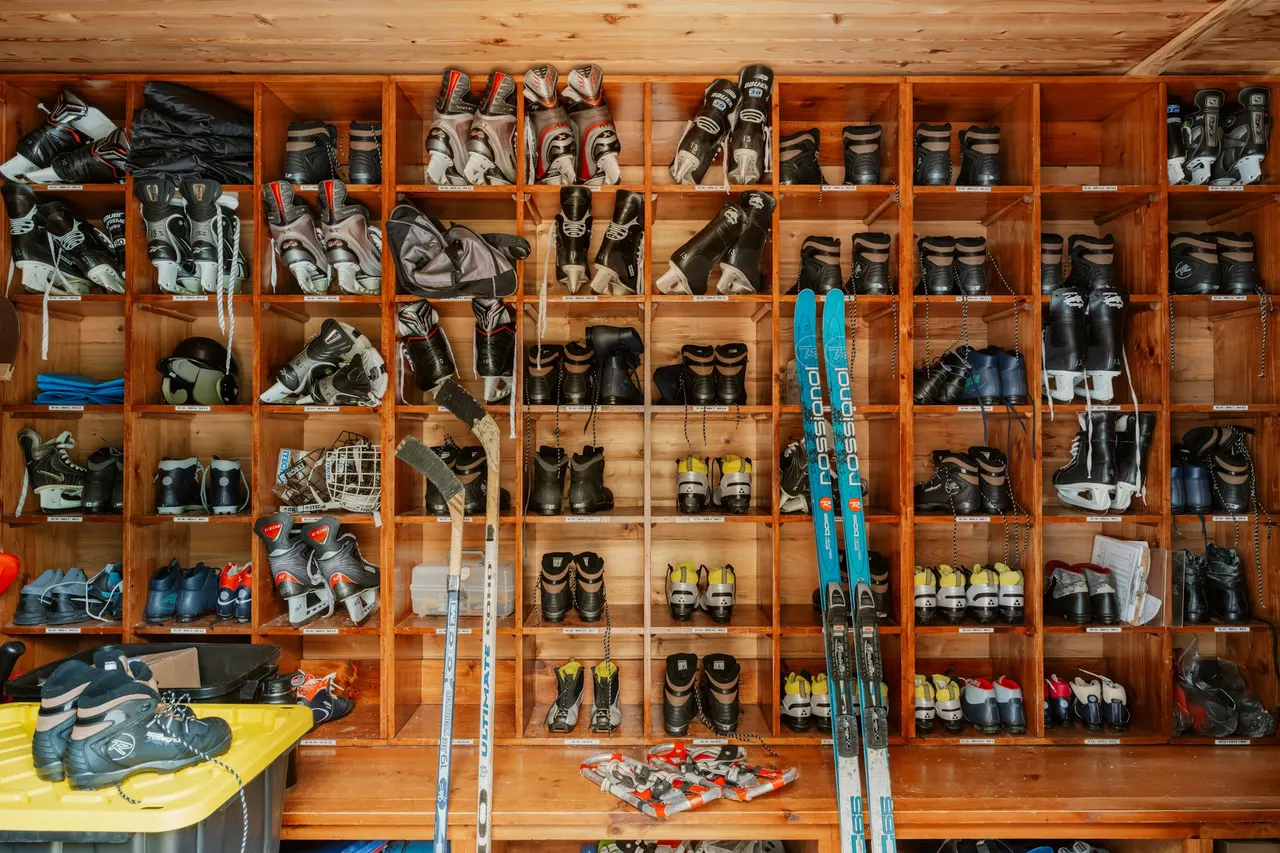
Have these bindings been adjusted and checked for my actual boots and current information?
Are the boots and bindings compatible?
Have I described my skiing experience and intended use accurately?
How should I clear snow from the boot and step into this system correctly?
What should I do if a ski releases unexpectedly or something feels wrong?
Bring equipment concerns back to the shop. An instructor can identify a reason to stop using equipment, but a lesson does not replace a qualified technician's adjustment and checks.
Snowboarding wrist protection: prepare before the first fall
Consider wrist guards that fit with your gloves
The American Society for Surgery of the Hand recommends wrist guards beneath gloves or gloves with built-in guards. Check that the equipment fits comfortably together and does not interfere with normal use of your gear.
Wrist guards reduce a specific exposure; they do not make every fall safe or protect every part of the arm. A history of wrist injury deserves individual medical advice rather than a promise that a guard will solve it.
Learn controlled movement and falls in person
New snowboarders need practice getting up, moving around and controlling both edges on suitable terrain. Ask your instructor to introduce appropriate falling skills as part of the lesson rather than relying on a rule such as always landing on fists or always putting an arm out.
Mass General Brigham's snowboarding guidance describes wrist injuries and recommends considering wrist guards. It also highlights instruction and awareness as part of preparation. A controlled learning environment is more useful than treating repeated uncontrolled falls as something you must endure.
Tell the instructor if one edge feels unmanageable or if getting up is exhausting you. A different task or a break can be the appropriate next step.
Manage fatigue before it decides the lesson for you
You do not need to wait for pain to take a break. If an exercise is no longer repeatable, explain what changed: your legs are tiring, your hands are cold or you are reacting too slowly to instructions.
The American Academy of Orthopaedic Surgeons recommends matching terrain to ability, taking lessons, using properly adjusted equipment and wearing a ski helmet. Its advice also cautions against attempting a difficult run when already fatigued after a full day.
For a first trip, leave time for rental fitting, a gentle warm-up, food, water and rest. Do not use the price of a lift pass or a full-day booking as a reason to continue when you are no longer moving in control.
Private coaching can help here. An instructor can work on an inefficient stance, reduce the complexity of the task and plan breaks around your group. That supports better learning and fatigue management without guaranteeing that an injury cannot occur.
What a private lesson adds to your injury-prevention plan
In a 100% private session, you can repeat the skill that needs attention without pressure to keep up with a commercial group of ten unfamiliar people. You can also say that an exercise hurts or that you need to stop without worrying about another group's timetable.
Lessons entirely in English, Spanish or Portuguese help you understand corrections and describe discomfort clearly. Ask your instructor to work on controlled stopping, appropriate terrain choices and a manageable pace before chasing distance or speed.
Ski Resort Lessons is an independent online platform connecting clients with qualified, experienced independent ski and snowboard instructors. It is not the resort-owned official ski school. Instruction complements equipment checks and medical preparation; it does not replace either.
Private lesson prices in the United States and Canada
Three-hour half-day sessions start at $449 USD and six-hour full-day sessions at $599 USD, for one person. Add $100 USD for the second participant and $50 USD for each additional participant. Groups can include up to four beginners or six intermediate or advanced participants.
Four beginners sharing a three-hour session pay $649 USD total, or $162.25 USD each. Share with people whose sport, ability and goals suit the same lesson rather than letting the strongest participant set everyone's pace.
Coordinate the meeting point, passes and equipment rental directly by WhatsApp before the session. Passes and rental are separate arrangements. For Japan, request availability and a quote for your chosen resort and dates through the booking process and WhatsApp.
SRL's 100% Weather Guarantee provides free rescheduling or a full refund if the resort closes its slopes because of a storm. It is separate from medical insurance and does not automatically cover injury-related cancellations.
After a fall: when to stop and get medical help
A blog cannot tell you whether a painful knee is a sprain or an ACL injury, or whether a wrist is bruised or broken. Do not use the ability to stand briefly as clearance to keep skiing.
| What happens | Appropriate next step |
|---|---|
| The knee is very painful, badly swollen, gives way, locks or cannot bear weight. | Stop and arrange prompt medical assessment. Ask ski patrol for help if you cannot get down safely. |
| A wrist is painful, swollen, bruised or difficult to use after a fall. | Stop riding and seek medical advice; a fracture can be difficult to distinguish from a sprain without assessment. |
| The injured arm or wrist is numb, has changed shape or color, has a heavy bleeding wound or exposed bone. | Treat this as an emergency and contact ski patrol or local emergency services. |
These warning signs follow NHS knee-pain guidance and its advice on a possible broken arm or wrist. Arrange help where you are rather than trying to ski an injured limb down the mountain or diagnose it from a photo.
Why a ski injury can become a substantial medical bill
The first consultation may be only one part of care. An injury can also require imaging, specialist assessment, immobilization, transport or hospital treatment. It would be misleading to say every base-clinic visit costs thousands, but a serious episode can involve that scale of expense.
Two documented transport examples illustrate the exposure:
Park City Fire District lists paramedic ground transport at $2,383.73 USD plus $42.24 USD per mile under its schedule effective July 1, 2025. These charges are for transport, before hospital treatment. See the district's EMS billing information.
BC Emergency Health Services lists CAD 848 for ground ambulance transport and CAD 4,394 per hour for helicopter ambulance service for people without provincial medical coverage. See its ambulance fee schedule.
These published fees were checked November 3, 2026, and may change. They are not a quote for your case or a guarantee that a particular service will be needed. They show why a ski trip's financial plan should extend beyond the lesson and rental booking.
For any destination, including Japan, confirm medical arrangements and insurance before traveling. Do not assume your domestic health policy or a credit-card benefit automatically covers your chosen snow sport overseas.
World Nomads vs. SafetyWing for ski and snowboard injuries
Affiliate Disclosure: This article contains affiliate links to World Nomads and SafetyWing. Ski Resort Lessons may receive a commission if you purchase through these links.
| Provider | Relevant recreational snow-sports coverage | What to check for your trip |
|---|---|---|
| SafetyWing | Essential lists recreational skiing and snowboarding subject to its conditions, excluding off-piste activity and activity against local safety advice. Complete advertises on-piste ski and snowboard injury coverage with a helmet requirement. | Confirm residence eligibility, the selected product, destination coverage and safety rules. Do not assume an adventure-sports add-on removes the off-piste exclusion. |
| World Nomads | Options may include skiing and snowboarding off-piste within resort boundaries, depending on residence and plan. Its US product page lists in-bounds on-piste and off-piste activity under Standard, with broader activities under Explorer. | Read the wording for your residence. Some markets require a winter-sports upgrade. Terrain parks, backcountry and closed areas are separate coverage questions. |
These summaries follow SafetyWing's sports FAQ, its Complete product information and World Nomads' US skiing and snowboarding guidance. Complete has a 12-month commitment, so compare enrollment and duration requirements with your actual holiday.
Ask about the treatment pathway, not just the sport name
Before buying, confirm how the policy treats emergency medical care, imaging, ambulance transport and medically necessary evacuation. Ask separately about follow-up treatment, rehabilitation and care after returning home; do not assume a benefit for the initial injury pays for the entire recovery.
Check deductibles, pre-existing-condition exclusions and assistance procedures. For Colorado or Utah, confirm US coverage. An old knee injury or previously treated wrist condition may affect eligibility for a claim, so obtain the insurer's guidance before relying on the policy.
Equipment care and lesson choice do not establish insurance coverage by themselves. Read the issued policy, stay within your ability and follow local restrictions even if a marketing page lists your sport.
A short checklist before your first lesson
Tell the rental technician your current information and use the boots checked with your bindings.
Wear a properly fitted snow-sports helmet and discuss wrist guards if snowboarding.
Explain previous injuries or relevant activity restrictions to your instructor.
Begin on terrain where the chosen exercise is manageable.
Agree on breaks and speak up when pain, fatigue or loss of control appears.
Know how to contact ski patrol and keep your insurer's assistance details accessible.
Frequently asked questions
Will a lower DIN setting protect my ACL?
There is no single lower setting that guarantees ACL protection. Changing release values affects retention and release behavior. Discuss your equipment and concerns with a qualified binding technician rather than changing the number yourself.
Are wrist guards enough to prevent a snowboarding fracture?
No protective item eliminates every injury. Wrist guards are recommended in hand-surgery guidance, but fit, technique, terrain and the circumstances of a fall still matter. Seek assessment after a painful fall rather than assuming the guard ruled out a fracture.
Should I keep skiing after a knee pop?
Stop and arrange assessment, particularly if there is pain, swelling, instability or difficulty bearing weight. A sound or sensation alone does not diagnose an ACL injury, and continuing is not a useful way to test the knee.
Can a private lesson replace pre-trip conditioning?
No. Coaching develops snow-specific skills and helps manage the session. Physical preparation, appropriate equipment and individual medical advice for relevant conditions remain separate parts of your plan.