Learning to Ski or Snowboard as a Nervous Adult Over 30, 40 or 50: How Private Coaching Builds Confidence
Learning to ski or snowboard after 30, 40 or 50? Build speed control at your own pace with private coaching, gentle terrain and winter-sports cover.
Ski Resort Lessons
You want to join the family ski trip. You like the idea of snowy mountains, long lunches and learning something new. What you do not like is the thought of sliding downhill without knowing how to stop.
Learning to ski as a nervous adult starts with making the task manageable: suitable terrain, a reliable way to slow down, small steps and permission to repeat them. You do not need to become fearless before your first lesson. You need an environment where you can learn control without being rushed.
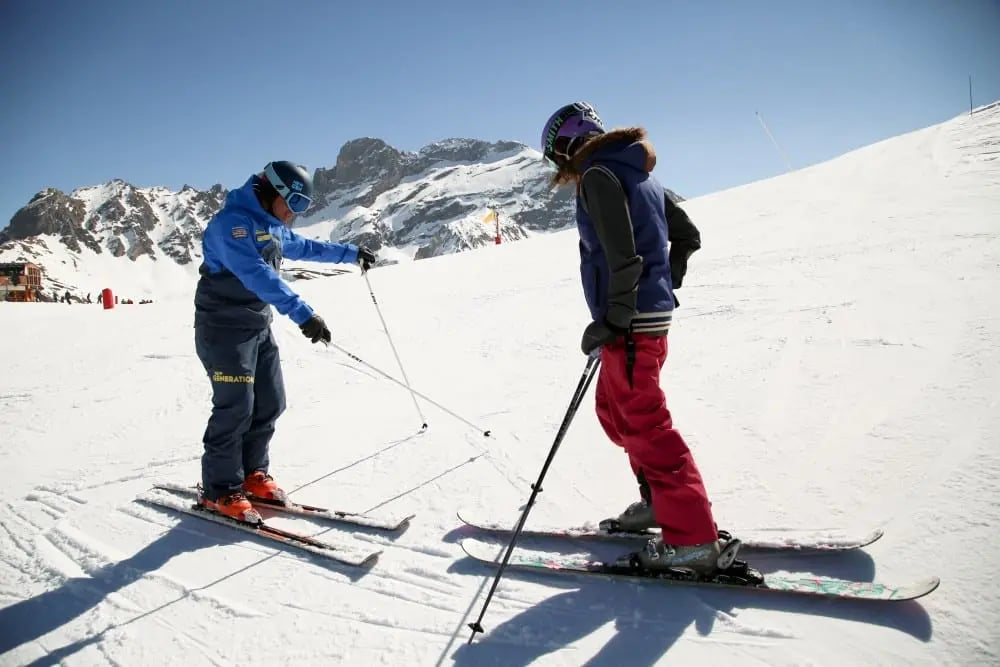
A private coach can organize that environment around you. Instead of trying to keep pace with ten unfamiliar people, you can work on the particular movement, slope or situation that makes you hesitate. Fear may not disappear in one session, but your next step can become much clearer.
Can you learn to ski or snowboard after 30, 40 or 50?
Yes, adults can start either sport in their thirties, forties, fifties and beyond. Your birthday alone does not tell an instructor what terrain you should use or how quickly you will progress. Current fitness, movement comfort, previous experience and personal goals are more useful starting points.
You might be comfortable cycling but unfamiliar with slippery surfaces. You might have strong legs but dislike heights. Or you might be returning after a bad experience years ago. Those are different teaching needs, even if everyone in the lesson is the same age.
Tell your instructor what matters to you: finishing an easy run comfortably, controlling the board without panic or enjoying a morning with your children. If a previous injury or health condition affects exercise, discuss participation with your healthcare professional before traveling.
You are allowed to define success as learning to stop on a gentle slope. A summit photo is optional.
Find out what you are actually afraid of
“I am nervous” is a useful opening. A more specific description helps your coach change the lesson.
| Your concern | What to discuss with your instructor |
|---|---|
| “Once I start sliding, I cannot stop.” | Begin with short, supervised glides and a stopping task on suitable learning terrain. |
| “Other people will hit me.” | Choose an appropriate practice space and work on observation, predictable movement and safe stopping locations. |
| “I will hold everyone back.” | Book one-to-one instruction or share only with people whose needs and pace fit yours. |
| “I am afraid of the chairlift.” | Explain this before the session so lift choice and preparation can be planned. |
| “I fell last time and cannot relax.” | Describe what happened and rebuild from a task you can manage, rather than repeating the same intimidating run. |
Writing your concern down before the trip can make the conversation easier. The NHS guide to tackling worries recommends identifying practical problems and making specific plans. On snow, that might mean asking to practice stopping before taking a longer lift.
Why control comes before speed
When someone says “just go faster,” they may be skipping the skill you need most: knowing how to regulate your movement. A nervous beginner should not have to accelerate beyond their ability to demonstrate commitment.
For skiers, a coach can help you understand how the direction and shape of a turn affect your speed. The task is to guide the skis along an appropriate path, rather than pointing straight downhill and trying to make an ever-larger braking wedge. Terrain, space and snow conditions determine which exercise is suitable.
PSIA-AASI Eastern's instructor guidance emphasizes acknowledging adult fear and developing a sense of control through turn shape. See its SnowPro teaching discussion. That is a teaching principle, not a promise that a particular drill will remove fear for everyone.
For snowboarders, the first confidence milestone may be controlling a gentle sideslip and stopping on an edge before attempting linked turns. Your instructor can separate heel-edge and toe-edge tasks, choose suitable terrain and decide when you are ready to combine movements. You do not have to point the board straight down a full run to prove that you are learning.
Practice control before increasing the challenge. A lesson can return to a simpler task whenever the current one becomes overwhelming.
A five-step confidence progression for your first lessons
This is an example to discuss with your coach, not a fixed curriculum or a set of exercises to attempt alone. Each step can take part of a session or several visits.
Step 1: Get comfortable before sliding
Start with equipment, balance and moving around on flat snow. Ask how to carry your gear, where to stand and what happens if you need a break. Boots should feel supportive; pain or numbness deserves attention from the rental team rather than encouragement to tolerate it.
Agree on a clear pause signal. You should know how to tell your instructor that you need to stop the exercise.
Step 2: Make the first glide short and predictable
Your coach chooses a suitable practice area and explains the intended route and stopping task before you move. Knowing what comes next is more useful than being told that a slope is “easy.”
Repeat the same manageable task until it feels more familiar. There is no benefit in rushing away from the learning area simply because another beginner progresses sooner.
Step 3: Build a stopping skill you can repeat
One successful stop is encouraging. Repeating it gives both you and the instructor more information about readiness.
For a skier, this may involve a controlled wedge or a turn toward a planned stopping area. For a snowboarder, it may involve maintaining and adjusting an edge during a short sideslip. The instructor selects the method and gives individual feedback.
Step 4: Add one change at a time
Try a slightly longer glide, a new direction or a simple turn before combining several new demands. Increasing slope steepness, changing snow and introducing a new lift all at once makes it harder to identify what is causing difficulty.
The NHS discussion of facing fears describes breaking challenges into smaller steps. In skiing, that idea must stay within your actual ability and mountain conditions. It is not a reason to enter terrain you cannot control.
Step 5: Repeat the skill without chasing a new trail color
Finish by noticing something observable: you stopped where intended, controlled a short descent or completed a turn without rushing. Your coach can suggest what to repeat next time.
An easy run done with more control is progress. You do not need a steeper run to validate it.
What to do if you freeze halfway through a run
Tell your instructor immediately. Avoid suddenly sitting down or stopping where people above cannot see you. If you can still move in control, follow your instructor's directions to a visible stopping location with room for others to pass.
Once stopped, explain what changed: the slope looks steeper, your legs feel tired or you no longer trust your stopping skill. Your coach can reassess the task, choose an appropriate route or seek help if needed. If you cannot descend safely, contacting ski patrol is a sensible decision.
Calm breathing may help you settle while stationary, but it does not replace a missing skiing skill or make unsuitable terrain safe. Persistent panic, distress after a previous accident or anxiety that affects daily life may also deserve support from a qualified healthcare professional. A ski instructor provides coaching, not mental-health treatment.
Beaver Creek or Deer Valley for a nervous adult beginner?
Both destinations offer recognizable learning areas, but they are not interchangeable for a mixed ski-and-snowboard party.
Beaver Creek: discuss the learning area before the lesson
Haymeadow Park is a dedicated base-area learning zone. Beaver Creek also identifies Red Buffalo Park and McCoy Park as progression areas. These names give you something specific to discuss with your instructor; they do not mean every area is appropriate for your first hour.
Ask where your session will begin, how you will access the terrain and whether any lesson-area access restrictions affect the plan. Current conditions, lift operation and your ability should guide the choice. Do not assume a particular facility is included with an independently arranged lesson.
Deer Valley: an option for skiers, not snowboarders
Deer Valley is ski-only and does not allow snowboarding. If you want to learn to ride a snowboard, choose another destination before booking accommodation, passes or instruction.
For skiers, Wide West is a learning-area name to discuss when arranging private ski lessons in Deer Valley. Ask your coach to confirm a suitable meeting point and practice plan for your dates. A famous resort name matters less than whether the actual session matches your needs.
Destination facts checked November 2, 2026, against Beaver Creek's Signature Parks information and Deer Valley's published FAQs and first-timer guidance.
Choose a private lesson around your needs and energy
A private lesson lets you spend longer on the part that feels uncertain, receive feedback directly and take a break without trying to match a large group's pace. It can also make it easier to explain a problem in your strongest language.
Ski Resort Lessons is an independent online platform connecting clients with qualified, experienced independent ski and snowboard instructors. It is not the resort-owned official ski school. Lessons are 100% private and available entirely in English, Spanish or Portuguese.
For a nervous first-timer, one-to-one coaching offers the most individual attention. Sharing can work when participants have compatible levels and goals, but a confident partner should not determine the pace of someone still learning to stop.
United States and Canada: clear prices and group limits
| Private session | Starting price for one person | Additional participants |
|---|---|---|
| Half day, 3 hours | $449 USD | Add $100 USD for the second person, then $50 USD for each additional person. |
| Full day, 6 hours | $599 USD | Add $100 USD for the second person, then $50 USD for each additional person. |
Groups can include up to four beginners or six intermediate or advanced participants. Four beginners sharing a three-hour session pay $649 USD total, or $162.25 USD per person. These are group totals with participant supplements, not a single base price covering everyone.
A full day gives you more scheduled time; it does not require you to push through fatigue. Discuss pacing and breaks before choosing the duration. Coordinate meeting points, passes and equipment rental directly by WhatsApp before the lesson.
SRL's 100% Weather Guarantee provides free rescheduling or a full refund if the resort closes its slopes because of a storm. It does not automatically cover a change of mind, fear or an unrelated cancellation.
If you are considering Japan instead, request availability and a quote for your resort and dates through the booking process and WhatsApp.
Take injury concerns seriously without letting them define the trip
You do not have to pretend that falls never happen. Prepare for them by choosing terrain that matches your ability, using properly fitted equipment and asking your instructor to teach appropriate movement and falling skills in person.
The American Academy of Orthopaedic Surgeons recommends lessons for new skiers, suitable runs, properly adjusted equipment and a ski helmet. It also cautions against taking on a difficult run when fatigued. For snowboarders, the American Society for Surgery of the Hand recommends wrist guards as part of injury prevention.
A coach can help address a tiring stance or an unsuitable exercise before you keep repeating it. That can support better fatigue management, but coaching and protective equipment cannot guarantee an injury-free trip. Pain, dizziness or inability to control your movements is a reason to stop and reassess, not a test of determination.
Winter-sports insurance: make the financial plan before your first lesson
A concern about medical bills is practical. A knee injury, wrist fracture or collision can involve assessment, imaging, transport and further treatment. A simple clinic visit does not necessarily cost thousands, but the care needed after a serious incident can extend far beyond that first consultation.
For example, the Park City Fire District publishes a paramedic ground-transport charge of $2,383.73 USD plus $42.24 USD per mile under its schedule effective July 1, 2025. That is transport before hospital charges, not a routine clinic tariff. See the district's ambulance billing information. Rates were checked November 2, 2026, and may change.
SafetyWing vs. World Nomads for a cautious beginner
Affiliate Disclosure: This article contains affiliate links to SafetyWing and World Nomads. Ski Resort Lessons may receive a commission if you purchase through these links.
| Provider | How recreational skiing and snowboarding may fit | What to verify before buying |
|---|---|---|
| SafetyWing | Essential includes recreational skiing and snowboarding subject to its terms, excluding off-piste activity and activity against local safety advice. Complete also advertises on-piste ski and snowboard injury coverage, with a helmet requirement. | Confirm your chosen product, eligible residence, destination coverage and safety conditions. Do not assume an adventure-sports add-on removes the off-piste exclusion. |
| World Nomads | Options can include on-piste and off-piste activity within resort boundaries, depending on residence and plan. Its US product page lists in-bounds on-piste and off-piste skiing and snowboarding under Standard, with broader activities under Explorer. | Read the policy issued for your residence and activity. An upgrade may be required in other markets. Coverage for ordinary beginner runs does not establish coverage for every terrain park or backcountry activity. |
These summaries draw on SafetyWing's sports FAQ, its Complete product description and World Nomads' US skiing and snowboarding guidance. Complete is a longer-term health product with a 12-month commitment, so compare its enrollment and duration conditions with your actual vacation needs.
For Colorado or Utah, confirm that the policy includes your US trip. Also check deductibles, pre-existing-condition exclusions, medically necessary evacuation and the process for contacting assistance. A nervous beginner does not need off-piste terrain to have a rewarding holiday; choose insurance for the activities you will actually do and remain within your ability.
Frequently asked questions
Is 50 too old to start skiing or snowboarding?
Age 50 is not an automatic barrier. Discuss your health, movement comfort and goals when planning the trip. Start with suitable terrain and instruction, and avoid measuring your progress against a much younger companion or someone who learned years ago.
How many private lessons will I need to stop feeling scared?
There is no reliable number that applies to everyone. Ask for skill-based goals, such as repeating a controlled stop or completing a short descent, rather than a guarantee that fear will disappear after a set number of hours.
Should my partner teach me instead?
A supportive partner can be good company, but being an experienced skier is different from teaching a nervous beginner. Private instruction gives you a dedicated learning plan and feedback while allowing your partner to enjoy their own skiing time.
Should I choose skiing or snowboarding if I am nervous?
Discuss the sport you want to learn, any physical limitations and what feels intimidating with your instructor. Neither sport is fear-free or fall-free. The useful starting point is a suitable practice environment, not a promise that one choice will be easy for everyone.